Friday, September 22, 2017
The United States conducted numerous atomic tests in the 1950s in Nevada. James T. Tracy, Sergeant First Class, U.S. Army, participated in the Atmospheric Nuclear Test Upshot-Knothole (Encore) on May 8, 1953. This YouTube video describes the weapon program. The following is James T. Tracy's personal account of his experience. It is being submitted to the Wisconsin Veterans Museum Oral History Program.
Nevada Test Site – 1953
Upshot-Knothole (Encore)
Upshot-Knothole (Encore) was scheduled for May 7, 1953, but
due to inclement weather it was postponed until the following day, May 8,
1953. It was one of eleven atomic
detonations in a series that took place at the Nevada Proving Grounds (Camp
Desert Rock) in 1953. The “shot” was of
the airburst variety, the bomb being dropped from an aircraft at the tower at
ground zero. 18,000 U. S. military
personnel took part in these 1953 tests; approximately 1,635 participated at
each “shot.”
I was First Sergeant of “D” Company, 701st
Armored Infantry Battalion (AIB), 1st Armored Division, Fort Hood,
Texas and went by troop train from Fort Hood, Texas to Camp Desert Rock, Nevada
arriving on or about May 5, 1953. To get
onto the test site the participants all had to have a top security
clearance. Due to my work with the
security platoon, 6th Armored Cavalry Regiment (ACR), Straubing,
Germany, I had that security clearance since January of 1949.
On arrival at Camp Desert Rock, we “pitched” our tents on a
dry lake bed (Yucca Flats). We used
jackhammers to place the tent spikes in the hardened clay. We attended classes a couple of days concerning
the upcoming detonation scheduled for May 7th.
 The test was cancelled because of inclement weather and on
May 8, 1953 at 8:30 a.m. the bomb was dropped from an aircraft at a tower
target at ground zero. We were later
told that the Air Force missed the tower by 100 feet from 4 ½ miles in the
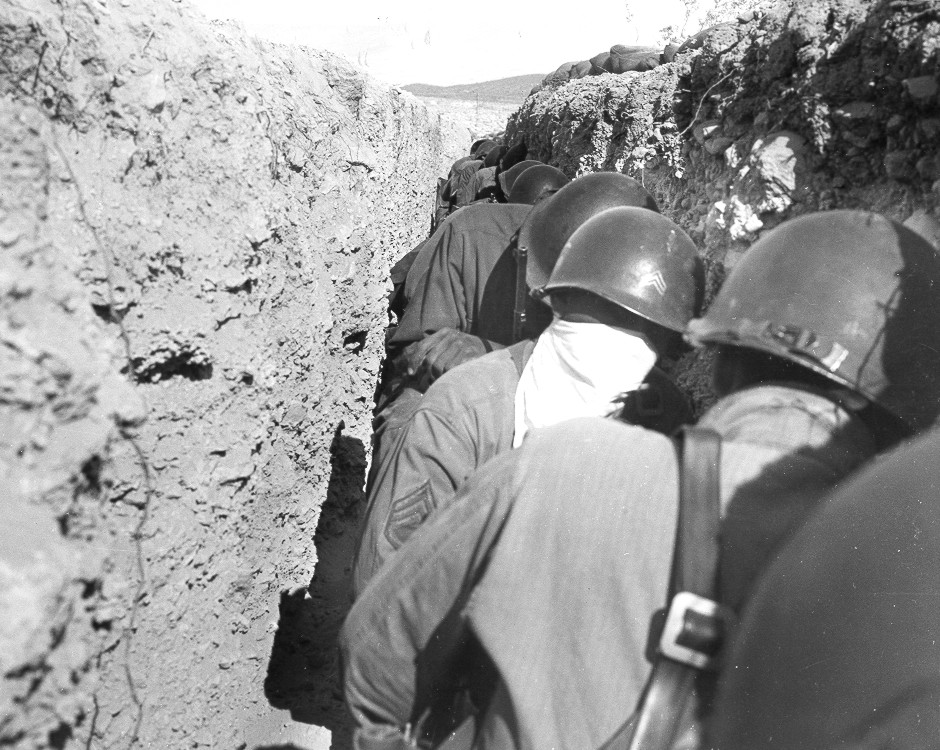
sky. We troops were in trenches 4-5 feet
deep about six miles from ground zero on our hands and knees and squinting our
eyes, as the officer counted down on the loud speaker – 10-9-8-7-6-5, etc. At the detonation, the ground shook and it
seemed like a high-powered search light was placed into our faces. After a couple of seconds the officer advised
us to stand up and look at the beautiful mushroom cloud forming in the
sky. The colors were brilliant – white (ice)
forming on top of colors of orange, red, pink, blue, etc. as the desert brush,
pebbles, and debris commenced to strike us in the face and front. The officer on the address system then
advised us that we would receive another surprise in about 20 seconds. The surprise was all of the debris that had struck
us in the face was now hitting us in our backs, as the vacuum from the heat was
drawing all of the desert debris back to ground zero.
The test was cancelled because of inclement weather and on
May 8, 1953 at 8:30 a.m. the bomb was dropped from an aircraft at a tower
target at ground zero. We were later
told that the Air Force missed the tower by 100 feet from 4 ½ miles in the
sky. We troops were in trenches 4-5 feet
deep about six miles from ground zero on our hands and knees and squinting our
eyes, as the officer counted down on the loud speaker – 10-9-8-7-6-5, etc. At the detonation, the ground shook and it
seemed like a high-powered search light was placed into our faces. After a couple of seconds the officer advised
us to stand up and look at the beautiful mushroom cloud forming in the
sky. The colors were brilliant – white (ice)
forming on top of colors of orange, red, pink, blue, etc. as the desert brush,
pebbles, and debris commenced to strike us in the face and front. The officer on the address system then
advised us that we would receive another surprise in about 20 seconds. The surprise was all of the debris that had struck
us in the face was now hitting us in our backs, as the vacuum from the heat was
drawing all of the desert debris back to ground zero.
Shortly thereafter we were ordered to walk across the desert
to ground zero to examine the displays at the tower. Enroute we saw sheep staked about every 500
yards—the first ones with their fur burned; the later ones looked like a cooked
roast. At the time I thought about my
veterinarian grandfather and cruelty to animals and the Humane Society and I was
really mixed up.
At the ground zero displays, machine gun barrels were melted
and sand bags (burlap) had been burned and were just a pile of sand. 2 ½ ton trucks and jeeps were overturned with
all tires and canvas melted and vehicles burned black. Brick, stone and wooden houses were demolished;
mannequins in the homes were charred beyond recognition. Broom straws were stuck into plastered walls
looking like darts in a target!
The troops participating in these exercises wore fatigue
uniforms with field jackets and no protective clothing. The entire scene at ground zero was
obliterated chaos.
It was an experience that I will never forget.
James T. Tracy
U.S. Army
Photos are from the internet, not from James T. Tracy's experience.
1 comments:
What a story, Shirley! Brought to mind a friend who died a year ago. He was a young seaman aboard a ship observing at Eniwetok. I well remember the day he told me he was there, how he volunteered and what he saw.
Post a Comment