Welcome to my blog.

This is my collection of family history stories and genealogy ideas. Contact me by leaving a note on this blog.

Civil War Series
Soldier Michael McDonald's personal accounts are featured.

>
Genealogy Lessons
Genealogy 101+ begins at this link.

Kewaunee The County Times Articles
Stories written for The County Times newspaper begin at this link.

Operation Upshot Knothole (Encore) Atomic Test

Friday, September 22, 2017

The United States conducted numerous atomic tests in the 1950s in Nevada.  James T. Tracy, Sergeant First Class, U.S. Army, participated in the Atmospheric Nuclear Test Upshot-Knothole (Encore) on May 8, 1953.  This YouTube  video describes the weapon program.  The following is James T. Tracy's personal account of his experience.  It is being submitted to the Wisconsin Veterans Museum Oral History Program.  

Nevada Test Site – 1953

Upshot-Knothole (Encore)

Upshot-Knothole (Encore) was scheduled for May 7, 1953, but due to inclement weather it was postponed until the following day, May 8, 1953.  It was one of eleven atomic detonations in a series that took place at the Nevada Proving Grounds (Camp Desert Rock) in 1953.  The “shot” was of the airburst variety, the bomb being dropped from an aircraft at the tower at ground zero.  18,000 U. S. military personnel took part in these 1953 tests; approximately 1,635 participated at each “shot.”

I was First Sergeant of “D” Company, 701st Armored Infantry Battalion (AIB), 1st Armored Division, Fort Hood, Texas and went by troop train from Fort Hood, Texas to Camp Desert Rock, Nevada arriving on or about May 5, 1953.  To get onto the test site the participants all had to have a top security clearance.  Due to my work with the security platoon, 6th Armored Cavalry Regiment (ACR), Straubing, Germany, I had that security clearance since January of 1949.

On arrival at Camp Desert Rock, we “pitched” our tents on a dry lake bed (Yucca Flats).  We used jackhammers to place the tent spikes in the hardened clay.  We attended classes a couple of days concerning the upcoming detonation scheduled for May 7th.
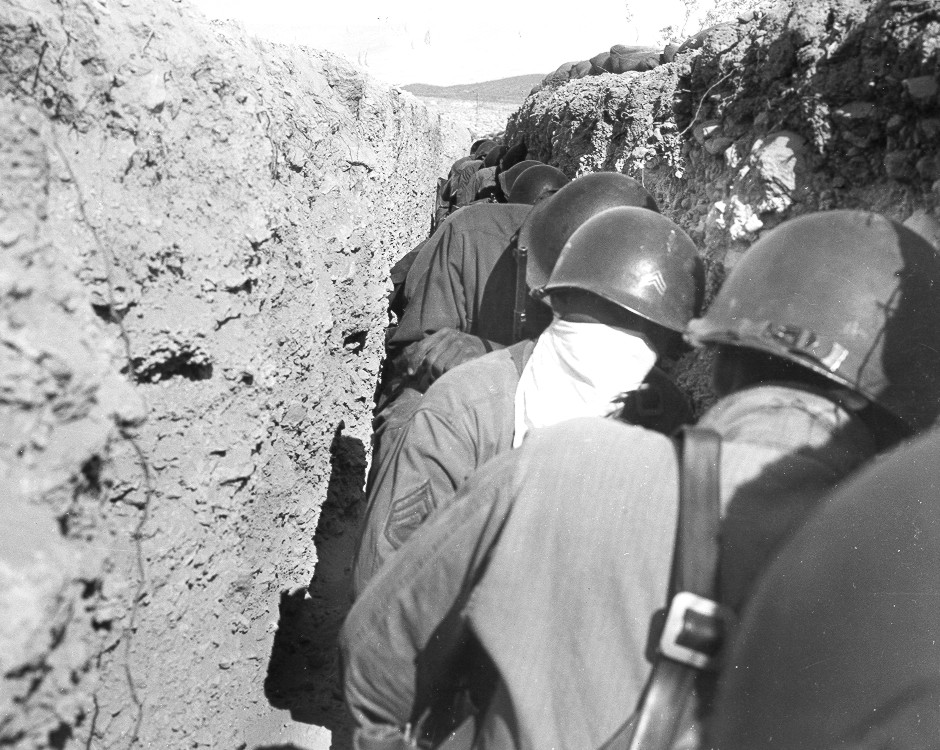
Image result for Upshot Knothole (Encore) pictures
Image result for Upshot Knothole (Encore) picturesThe test was cancelled because of inclement weather and on May 8, 1953 at 8:30 a.m. the bomb was dropped from an aircraft at a tower target at ground zero.  We were later told that the Air Force missed the tower by 100 feet from 4 ½ miles in the sky.  We troops were in trenches 4-5 feet deep about six miles from ground zero on our hands and knees and squinting our eyes, as the officer counted down on the loud speaker – 10-9-8-7-6-5, etc.  At the detonation, the ground shook and it seemed like a high-powered search light was placed into our faces.  After a couple of seconds the officer advised us to stand up and look at the beautiful mushroom cloud forming in the sky.  The colors were brilliant – white (ice) forming on top of colors of orange, red, pink, blue, etc. as the desert brush, pebbles, and debris commenced to strike us in the face and front.  The officer on the address system then advised us that we would receive another surprise in about 20 seconds.  The surprise was all of the debris that had struck us in the face was now hitting us in our backs, as the vacuum from the heat was drawing all of the desert debris back to ground zero. 

Shortly thereafter we were ordered to walk across the desert to ground zero to examine the displays at the tower.  Enroute we saw sheep staked about every 500 yards—the first ones with their fur burned; the later ones looked like a cooked roast.  At the time I thought about my veterinarian grandfather and cruelty to animals and the Humane Society and I was really mixed up. 

At the ground zero displays, machine gun barrels were melted and sand bags (burlap) had been burned and were just a pile of sand.  2 ½ ton trucks and jeeps were overturned with all tires and canvas melted and vehicles burned black.  Brick, stone and wooden houses were demolished; mannequins in the homes were charred beyond recognition.  Broom straws were stuck into plastered walls looking like darts in a target!

The troops participating in these exercises wore fatigue uniforms with field jackets and no protective clothing.  The entire scene at ground zero was obliterated chaos.

It was an experience that I will never forget.

James T. Tracy

U.S. Army 

Photos are from the internet, not from James T. Tracy's experience.

Straubing's Geschwister Scheitzach Sanger und Schuhplattler Truppe (of 1915)

Friday, February 12, 2016


 Scheitzach Children's Singing and German Dancing Troupe

One day when I was a teenager I was sitting at the kitchen table doing my homework when I asked my mom to make some dessert for me to take to German class at school.

“Herr Swoboda likes your strudel so he came up with a reason to have another one of his ‘cultural’ days this Friday.” 

She probably answered me with “I’ll see what I can do.” 

German language class was one thing my mother and I had in common to talk about.  Throughout my childhood, Mom, who was born in and grew up in Straubing, Germany, lightly peppered our talks with names of German food and tales of her childhood.  ‘Lightly pfeffered’ might be an overstatement.  She was fairly close-lipped about what must have been a very challenging time growing up in wartime Germany and rarely said anything about her family.

As the conversation went on, and while she folded yet another load of clothes out of the dryer, she stood at the table with me. 

I asked her what she did for fun and ‘culture’ when she was a kid or something along that line. 

She said she always wanted to play “one of those things, you know…” and she mimicked playing an accordion.

“Oh, I didn’t know that,” I replied.  “Did anyone in your family play any musical instruments?”

That’s when she told me that her grandfather Scheitzach was a musician.  And, that the family had a Schuhplattler troupe.

“What’s that?” I asked.

She likely made a few classic Schuhplattler moves and I, being an idiot, probably laughed because then she said, “Oh, you kids!  You think everything is dumb!” 

That shut her up.  I wasn’t going to hear any more about it after that. 

Fast forward to last year. 

While doing genealogy research on my German ancestry, I Googled ‘Straubing, Scheitzach, and Schuhplattler.’  I came across a foreign ebay-like site and a picture of a postcard of Straubing's Geschwister Scheitzach Sanger und Schuhplattler Truppe of 1915. 

What!?

Since then I have put the word out to my international contacts to identify what the post card says.  Hoping to identify the lady and children on the card, I have connected with other Scheitzachs.  I have learned that what is written on the postcard is the name of the person who sent it—Ersatz-Reservist K. Wallmoller or Waltmuller.  He was a corporal replacement reservist in German Infantry Regiment 10 in Straubing.  I also learned that my mother’s grandfather, the Musiker (musician), Great Grandfather Georg Scheitzach, was a WWI German soldier and later a reservist.

So, while I have not yet identified the people, I’m calling them my kin.  They are in the right place at the right time with the right name to be my family's Scheitzach Schuhplattlers.

I absolutely love this picture.        


Winter at Valley Forge

Monday, January 4, 2016

Although not a single battle was fought there, nearly 2,000 Revolutionary War soldiers died at Valley Forge.  Those who survived were trained to become real soldiers in an army that could fend off the professional British military.  

Valley Forge
Valley Forge, Pennsylvania is a site about 20 miles northwest of what was then the capital, Philadelphia.  Valley Forge became the winter quarters of General Washington.  It is where, in the fall of 1777, with cold weather coming on and after their defeat at Germantown on October 4, Washington's Continental Army moved to a place on high ground--a place that could be easily defended.

My ggggg-grandfather, Jesse Benjamin, a member of the fife corps, was among those soldiers who fought at Germantown and then wintered at Valley Forge with General George Washington.  

Replica hut at Valley Forge
12,000 men marched to Valley Forge.  They were soon tasked with building 2,000 military huts for housing and digging trenches to defend themselves.

While supplies were scarce at the beginning of the encampment, they became scarcer still as the winter wore on.  Clothing and boots were not uniformly available; some soldiers did without while some were adequately provisioned.  

Many soldiers fell ill.  Of the 2,000 who died there nearly 2/3 perished from disease.  Influenza, typhus and dysentery were common ailments until sanitation was improved.  


At Valley Forge, Washington knew his army needed to become better trained.  So, while in Paris, Benjamin Franklin recruited a member of the Prussian Army, Baron Friedrich Wilhelm von Steuben.  von Steuben was asked to design a military training program for the Continental Army at Valley Forge.  The baron spoke no English but with the help of interpreters created a model company of 100 men whom he instructed in drilling and maneuvering.  These 100 men then trained other units until the whole army was trained.
Monument at Valley Forge

Washington and his soldiers left Valley Forge on June 19 hot in pursuit after they learned that the British Army had evacuated Philadelphia. 

The Continentals soon caught up to the British Army.  In extremely hot weather, the positive results of von Steuben's soldiering program at Valley Forge were obvious when the Continental Army was able to fight to a draw against the professional British military at the Battle of Monmouth on June 28, 1778.    

Soldier Jesse Benjamin survived Valley Forge and the Battle of Monmouth.  He served for six years and earned the Badge of Merit from General Washington upon discharge.  

During my visit to Valley Forge in July 2015, I found the record of Jesse Benjamin's encampment on file there.   


Muster Roll record of Jesse Benjamin at Valley Forge

DEC 1777Sick In Hospital
JAN 1778Sick Absent
FEB 1778Sick Absent
MAR 1778Promoted To Fifer
APR 1778On Roll Without Comment
MAY 1778On Roll Without Comment
JUN 1778On Roll Without Comment

Be on the Lookout!

Sunday, February 15, 2015

Be on the lookout.  Two important pieces of Kewaunee County’s commemoration of the past have gone missing.

Two Heritage signs have disappeared.  The signs are historical markers that were erected by the Kewaunee County Historical Society (KCHS) to educate us about and to honor the county’s past.

Creating the signs was a project of the Historical Society’s Heritage Sign Committee headed by board member Donna Urban.  Over 30 signs were posted throughout the county about people and places of the county’s days gone by.  The signs highlight a variety of topics ranging from factories to a fire, Father Marquette to ferry service, farms to a financial institution.  The Heritage signs were produced locally and each sign includes an historical photo and explanation of the significance of the location in Kewaunee County history. 

Canning Factories Heritage Sign
The signs look like this example which is located on the east side (the lake side) of Knutson Hall on Lake Street in Algoma.  It marks the former location of canning factories.  The sign explains that canneries were located in Kewaunee and Algoma that processed local farm crops and provided jobs.  Built at the end of the 19th century, the canneries fell into decline after World War I due to competition from Green Bay plants.

Now two of these signs are missing.  The first one, about brickyards, was posted near the Algoma Chamber of Commerce building on the lakefront (State Road 42).  It explains that most of Algoma’s buildings before the great fire of 1871 were made of wood.  After the fire, local brickyards produced materials to build safer buildings.   

Location where the Railroads sign belongs
The other missing sign marked railroads of Kewaunee County.  In 2001, it was placed on Cedar Corners Road (County Road M) at the intersection with the Ahnapee Trail, north of Algoma.  This sign commemorates the importance of the railroad which tied the county with Sturgeon Bay, Green Bay and points beyond.  It explains that, no longer used by the railroad, the old rail right-of-ways were repurposed as hiking and biking trails. 

The missing railroad sign reads: “As people moved inland, away from navigable waterways, railroads provided the vital transportation link for freight and passengers before the arrival of motor vehicles.  Rail service reached Kewaunee County when the Kewaunee, Green Bay and Western Railroad was completed to Kewaunee in the fall of 1891.  The inauguration of carferry service across Lake Michigan the following year completed the east-west railroad link across the Upper Midwest. 
Edward Decker, a prominent county businessman who had extensive holdings in the Casco area, advanced most of the money needed to connect Ahnapee (Algoma) to Green Bay by way of Casco Junction.  Work on the Ahnapee and Western was completed in the fall of 1892.  Two years later, rail service was extended to Sturgeon Bay by way of Forestville and Maplewood. 
The railroad stimulated the lumber industry, which had moved inland to the Casco area.  With readily available transportation, business was flourishing.  Later cash crops—hay, peas, apples and cherries—were transported to market. 
By the 1920s, rail transportation was starting to be affected by competition from the trucking industry.  The Depression further cut into profits.  Freight shipments were declining, mail contracts were lost and passenger service was coming to an end. 
The segment from Algoma to Sturgeon Bay was abandoned in the late 1960s.  Various attempts, such as a passenger excursion train between Algoma and Casco Junction, were made to help the railroad survive, but eventually rail service was virtually abandoned in the county. 
Today, while trains no longer travel this railroad right-of-way, this century-old route now serves as a year-round recreational trail.” 

A website, Wisconsin Historical Markers, provides photos of most of the Kewaunee County historical signs as well as place descriptions and some latitude and longitude coordinates to help searchers, including geocachers, locate the KCHS Heritage markers.

To help publicize the markers and encourage driving tours to view the signs and locations throughout the county, the KCHS Research Center also offers a brochure with a map and detailed information.  

Kewaunee County Historical Society member Judy Srnka said the two signs went missing about a year ago.  Having checked with the city of Algoma, the KCHS is still unable to locate the signs.  Anyone with information about the location of a missing sign is asked to contact the Kewaunee County Historical Society at (92O) 388-0369 or stop at the Research Center at 217 Ellis Street in Kewaunee. 

It would be nice to get these records of the past back where they belong.

The Kewaunee Fire and the Wing Law Library

Friday, February 13, 2015


One night, long ago, thirty buildings burned to the ground in downtown Kewaunee. 

The fire started on May 19, 1898 in Ignatz Gunter’s hotel barn behind the Wing law office. 

Kewaunee County Historical Society Heritage sign
An area bounded by Kilbourn, Harrison, Milwaukee and Main Streets was heavily damaged.  Aided by a strong northeast wind, two blocks of businesses were turned to ash in a matter of minutes.  Destroyed in the fire were: the Ganter Hotel; the law office; Charles Metzner Clothing; a barber shop; Klemish Saloon; Gotstein Millinery; and the Putman and Dillon Meat Market. 

All was not a total loss; some buildings did survive including: Bach, Kieweg and Poser Store; Commercial Hotel; Bitzan Saloon; Mashak’s Hardware Store and the Bank of Kewaunee.

Attorney George W. Wing was particularly devastated by the loss.  He had been in law practice previously with his father, Rufus L. Wing, in Kewaunee and was, in 1898, in partnership with Charles Wattawa since 1894.  Wing’s stone block, which was built in 1892 at a cost of $5,000, was entirely destroyed.  With it went his library and his most valuable papers.  He had especially valued the law library because it had been his father’s.  Among its contents were many books from the library of his grandmother Wing’s relative, General B. J. “Jeff” Sweet of Camp Douglas fame.  Nearly 700 volumes were destroyed. Also burned in the fire was his certificate to practice law.
Attorney George W. Wing
 
According to G.W. Wing’s personal diary, after the fire, undaunted, he immediately moved into Grimmer’s block nearby and the next day ordered a new library.

Although Wing was disturbed by the loss, not everyone considered the fire to have been a terrible thing.  A newspaper article soon after said “Kewaunee business men are beginning to realize that the recent fire which destroyed a considerable section of the business part of that city may in the long run prove to be one of the best things that has ever happened for the place.”

Shortly after the fire, nearly $60,000 in cash was paid out by insurance companies.  It was noted that while a few of the lost buildings were good looking, substantial structures, most of them were old wooden buildings “worth just enough to prevent their owners from tearing them down.”  In some cases, the real estate, along with the insurance proceeds, was worth more than the entire property before the fire. 

It turned out that these statements were prophetic.  Within a few decades, the old was replaced with new brick and stone buildings and business was booming in the City of Kewaunee. 

In fact, at least until the Great Depression of the 1930s negated much of Kewaunee’s business boom following the fire of 1898, the blaze was actually a “blessing in disguise.” 

The Strange, Sad Story of Dr. John Oliver Taylor

Monday, January 5, 2015

After tea one Saturday evening in mid-August 1872, Lizzie Taylor sat reading when her husband, Dr. John Oliver Taylor, rose from his chair, picked up a small vial, tipped it to his lips and ended his life. 

Before he expired, he took off his coat and boots and, laying down on the bed, said to his wife:  “Lizzie, if you want to find any statement you’ll find it in the—in the—“  He died before he finished the sentence.  

Lizzie had noticed that John had placed something to his mouth but paid no attention to him doing so.  She believed it was a bottle of liquor that she knew he had stashed in the room. 

He had seemed much more cheerful on the day that he finally succumbed to depression.  There was nothing in his speech or behavior to raise suspicion of his intention to kill himself with an ounce of deadly hydrogen cyanide poison at the age of 33.  He left a letter he had written weeks earlier for his wife.  There was no inquest into his death.  

John Oliver Taylor was an Englishman, born in 1838.  Before taking his own life that summer evening in Kewaunee, the city likely knew little of the factual background of the man.  
   
According to an article in the Kewaunee newspaper a few days after his death, it was believed that Dr. Taylor was a graduate of King's College in London and that he received his medical degree in Edinburgh.  However, John Oliver Taylor did not qualify as a doctor in Edinburgh nor did he attend King's College in London.  Perhaps he believed no one would or could check his credentials at that time. 
Taylor actually began his medical training in Ceylon and Calcutta at the age of 19 in 1857.  Based on an article in the Medical Times and Gazette Medical News, John Oliver Taylor passed his examination in the Science and Practice of Medicine and received a Certificate to Practice as a general practitioner, not a surgeon, in June 1862 in Ceylon. 
Dr. Taylor married Elizabeth “Lizzie” Marks a year later, in June 1863 at St. Paul’s Cathedral in Calcutta. 
It is unlikely that people in Kewaunee knew that Dr. Taylor had been sentenced to six years penal servitude in India for forgery.   An October 1863 Indian newsletter called Allen’s Indian Mail published an article about the curious case of the Englishman Taylor who had “mixed in the best society of Calcutta.” 
Dr. John Oliver Taylor had learned of an account at the Bank of Bengal that belonged to a mariner pilot also named John Taylor.  Dr. Taylor boldly went to the bank, told them he was formerly a pilot and now a doctor, and wrote checks on the other man’s bank account.  Naturally the crime was discovered and Dr. Taylor was arrested.  He was tried in the High Court of Calcutta and found guilty.  Dr. Taylor was condemned to six years of penal servitude which, for a European in India, was nearly equal to capital punishment.      
William H. Upham
Photo from Wikipedia
Dr. Taylor, it was said, served for a number of years with the British Army in India.  If so, he did not serve his full jail sentence--maybe none of his sentence--because he and his family arrived in Boston on August 15, 1867.  He became a surgeon for the U.S. Army.  

While serving in the U. S. Army for two years, he met Lt. William H. Upham who was later the 18th governor of Wisconsin.  Through the efforts of Lt. Upham, in the fall of 1869, Dr. Taylor and his family came to live in Kewaunee where Taylor’s knowledge of his profession was generally accepted.  

Unfortunately, Dr. Taylor became addicted to opium and liquor.  He resolved to rid himself of the habits but to no avail.  The addiction and depression led to his self-inflicted demise.    

Dr. Taylor was buried in the Kewaunee Public Cemetery which is likely Riverview Cemetery.  His wife and four small children were left to mourn his untimely death.

Sir Edward Thornton
from Vanity Fair Magazine
His family was returned to England at the expense of the British government through the efforts of British Minister to the United States Sir Edward Thornton. 

What became of Dr. Taylor’s widow and children?  After returning to England, the family lived in Lewisham, Kent according to the England census of 1881.  His widow, Elizabeth, became a “School Mistress.”  She remarried in 1882 to her cousin, Francis MacDonald Swallow, who was also a doctor.  Elizabeth died in 1922 in Buckinghamshire, England according to family records.       

Both of Dr. Taylor’s daughters—Evelyn and Ida Lizzie—died in England, unmarried.    

Taylor’s first son, Charles, had witnessed Dr. Taylor’s suicide at three or four years of age.  What became of Charles is unknown; he could not be traced after the 1881 England census.    

Taylor’s second son was named Donald.  Donald’s first wife died in childbirth in 1904 in England.  Donald disappeared, leaving a three year-old son and five year-old daughter.  Records indicate that Donald remarried in 1905 but did not return for his children and was never seen by the family again.

Dr. Taylor’s real life story is one that qualifies as stranger than fiction.

Anyone with more information about Dr. Taylor or his family is asked to contact Shirley VerBruggen at sverbruggen@new.rr.com.  John Oliver Taylor’s descendants are very interested to learn more about him.   


New Year Calling

Tuesday, December 30, 2014

New Year “calling” was like speed dating in the 19th century.    

The custom, which is thought to have been brought to America by the Dutch, involved gentlemen visiting the homes of as many ladies as possible on New Year’s Day.  

Calling Card Tray
Ladies would announce that they would be receiving callers or it would simply be assumed so.  The women would get all gussied up.  The men would, too.  In gloves and ties, men came bearing calling cards (about the size of a playing card) which they carried in ample supply in the breast pocket of their coats.  Men would present their card or leave it in a basket or tray at each lady’s door. 

A lady’s door was open to any man of presentable appearance--acquaintance or stranger.  For the man, a sort of mad dash from home to home ensued.  A quick introduction or greeting at the door was followed by eating and perhaps downing a glass of wine, sharing a hearty wish for a happy New Year, and shaking hands.  Then the gentleman was out the door and on his way to the home of the next lady. 

It was the calling cards that ladies vied for.  While the men sought to visit the most women, the ladies wanted to collect the most calling cards.

There was a ritual to follow with calling cards.  If the lady desired to formally visit with a gentleman again, she would send a card in return.  If no card was sent or his card was returned in an envelope, this was a signal that the lady did not wish for a personal visit.  It was the 1800s equivalent of failing to accept a friend request on Facebook.    
   
By 1900, the practice was out of vogue.  The Algoma Press in December 1899 reported that New Year calling had pretty much died out.   The newspaper relayed that in places like New York it was already going extinct by the 1880s. 

Today, while it might be ludicrous to open one’s home to strangers for New Year calling, perhaps the distinctive and mannerly art of presenting a calling card might be a custom worth resurrecting. 


Calling card photos are from “The Gentleman’s Guide to the Calling Card” and “Days of Elegance” websites. 


Just the Way She Likes It

Wednesday, December 24, 2014

“It’s just the way I like it,” she says.

The “it” Arlene Jadin refers to is the home she has lived in for nearly 65 years.

“I’ve only lived in two houses in my lifetime,” she explains.  “I moved from my mother’s to my mother-in-law’s home when I got married in 1949.”
 
She lives in the farmhouse she shared with her husband, Darrell, their five daughters and one son.  Now, it is a welcoming place for her many friends and relatives.  It is also home to an eclectic variety of handmade decorations which are the result of Arlene’s many hobbies.
 
Outside, her yard hints at the crafty nature of the homeowner.  In the side yard, Santa drives a big, horse drawn wagon carrying a Christmas tree.  A ceramic raccoon peaks out from the corner of one of her farm buildings.  Mary and Joseph are nestled in a crèche near the front door of the house.  A windmill is adjacent to the driveway.

Step inside the 110-year-old farmhouse in Thiry Daems in rural Kewaunee County to see how Arlene has brought the outside in. The south facing sun porch is perfect for reading the newspaper and relaxing.  A canopy of many little birdhouses--no two alike--hangs overhead, stemming from a tree mural painted up the wall that spreads across the ceiling.  A beautiful, lush fern and other greenery give an impression of sitting in a park on a summer’s day.  Fairy gardens are tucked beside a tree covered with ornaments she made with colorful pheasant feathers.  No cats are allowed in her home because Arlene says her house is “for the birds.”   

Further inside, the scope of Arlene’s many hobbies and interests becomes obvious.  Featuring the home’s original wood floor, her Victorian parlor is filled with period-inspired furnishings.  On a wall, she displays treasured, old wedding photos honoring her family’s ancestors.  Using her 30+ years of experience as a bridal shop seamstress, she has fashioned beautiful miniature replicas of the wedding dresses worn by the women in the photographs.  Dolls on the fireplace mantle wear the tiny bridal garments she made of scrap fabric and lace—of her mother, mother-in-law and grandmother.  

In the same room, a store mannequin has been re-purposed.  “She had broken fingers and was going to the junk,” Arlene says, “so I brought her home, fixed her hand and dressed her up.”   Parts of an artificial Christmas tree form her dress and parasol.  Handmade ornaments adorn her skirt.  Glass and crystal icicles hang from her umbrella.  The resulting Victorian lady can only be described as stunning.

Where does Arlene get her unique decorating ideas?  She says she always enjoyed shopping—especially in Door County.  Over the years, when she didn’t have the money to buy everything she liked, she would sketch what she saw.  “I knew I could recreate it myself!” she exclaims. 

Obviously, she can!  Arlene has so many talents and interests.  She: has milked cows in the morning and again at night; can source organic meals from her farmland—from potatoes and carrots to rabbits--and tops off the dinners with homemade apple pie; refurbished the home’s original floors and furniture; paints and wallpapers; makes jam for gifts from the myriad variety of fruits she grows, and; has created a house full of the most unique décor imaginable. 

Furthermore, she’s eager to use her new toy--an ATV--to run through the woods.  She has a bottle of wine reserved for the first occasion.  “I’ll christen it with holy water,” she says, grinning.  “The wine is for drinking later.”

Arlene has plenty of friends and family with whom she shares her lovely country home.  Her kitchen table is ready to welcome guests, fully extended with all of its leaves.  She is set to host her children, grandchildren and great-grandchildren for a meal or up to ten guests each Sunday evening when friends gather there to play cards.  The card game of choice is a Belgian one pronounced 'Coo-you', she explains, “It's like Sheepshead but easier to play.”

Arlene says she’s a “fun-loving people person,” so the house is often full and noisy.  But, it is quiet sometimes, too.  “I have lots of friends to do something with, but I have nobody to do nothing with,” she adds.  “That’s okay, too.  That’s just the way it is and I like it.”      

My thanks to Arlene Jadin for the opportunity to interview her and visit her home.       

Jingle Bells

Monday, December 15, 2014

In 1857, when James Lord Pierpont wrote the song “One Horse Open Sleigh,” (more well-known as “Jingle Bells”) he did not neglect to include a common sleigh ride experience in the lyrics.  He wrote, “The horse was lean and lank, misfortune seemed his lot, he got into a drifted bank, and then we got upsot.”  Because, sleigh rides often ended with the sleigh “upsot.”  A lot.

Sleigh rides and sleigh ride parties were very popular in the 1800s and early 1900s.   Sometimes they were arranged by school groups, sometimes by friends and sometimes by church groups like the Ladies Aid of the Methodist Church.  The destination might be a winter picnic with a roaring bonfire, a friend’s home for an evening of entertainment or a dance hall for a party.

Who wouldn’t look forward to a lovely sleigh ride? Imagine the scene… The year is 1900. A jolly group is on a sleigh party, riding through the woods. The air is fresh and fragrant with the scent of pine and cedar trees. Snow sparkles like diamonds and covers the landscape. Horses, with harnesses laden with jingle bells, pull the sleigh. As the sled’s runners glide through the snow, friends are cuddled up under warm blankets and furs, giggling and singing...

 “Dashing through the snow, in a one-horse open sleigh, o’er the fields we go, laughing all the way, bells on bobtail ring, making spirits bright, what fun it is to ride and sing a sleighing song tonight!”
  
But, a sleigh ride was not for the unprepared; misfortune often befell the riders.

For example, in the winter of 1901, Miss Clara Bottkol of Euren invited 30 young people for a sleigh ride to her home.  She served an elegant supper followed by games and other entertainment which lasted until a few hours before midnight.  Then, her guests loaded the sleighs for the ride home.  Sledding conditions were poor on the return trip and the drivers had to follow the ditches to prevent the sleighs from tipping.  They had several near upsets.  The group finally arrived home, in time for breakfast. 

When Mr. Louis Kammer took a bunch out for a sleigh ride in December 1916, all went well until they reached Stony Creek.  That’s where Louis spilled the riders into a ditch.  Reportedly, no bones were broken.
  
And, a party of young folks from Sturgeon Bay rode to Ahnapee one cold night in January 1893.  On the way home, the cutter holding the gentleman and two ladies was upset in a snow drift a few miles from town.  Their horse ran home leaving the riders stranded.  Rescuers happened to see the horse and set out to bring the people home.  But, they too got upset and their horses returned to the stables, leaving the rescuers stranded, as well.  They all had to walk in the cold that night to find another team to hire to take them home. 

So, oh what fun it was to ride, unless the sleigh got “upsot!”

Pierpont’s “Jingle Bells,” with a few revised lyrics, became one of the most well-known holiday carols.  Perhaps the song resonated with so many people who: loved to take sleigh rides, liked to hold sleigh ride parties or had their own sleigh ride misadventures to tell. 

Shirley VerBruggen wishes you safe travels in your sleighs.  Enjoy Pierpont's song here.


Graphics are from Google.com .

Snake Oil Salesmen and Tippecanoe Too

Sunday, December 7, 2014

Got gout?  How about cough due to cold, convulsions, nervous prostration, brain worry, blood sores, or St. Vitus Dance (jerky movements of face or hands)?  If one suffered from any of these maladies in the 1880s there was sure to be a snake oil salesman ready to provide a cure.  Pages of old newspapers are filled with ads and testimonials for miracle cures for all sorts of ailments.
   
Readers were led to believe that Allen’s Lung Balsam cured a mother of consumption (TB).  Another testimonial claimed a severe case of bronchitis--one that had existed for twelve years--was cured by the Balsam.
 
Coughs, colds, croup?  There was a remedy fit for the whole family.  Always touted to be harmless to the most delicate child and containing no opium in any form, these bogus “medicines” were supposedly “recommended by physicians, ministers, and nurses.”  In fact, they were recommended by everyone who had given several bottles a good trial.  “Never failed to bring relief!” they claimed. 

    
Ailments you never hear of today could be cured with a good tonic.  Be it Scrofula, Kings Evil, Ugly Blood Disease, Catarrh, or Nervous Weakness, for $1.50 per bottle, the Dr. S. A. Richmond Medical Company would cure what ails.  Sold at all druggists! 

Apparently, a physician’s testimony was presumed to be very persuasive in an advertisement because the ads almost always touted an M.D.’s recommendation.  For instance, Dr. P. C. Ballou, of Monkton, Vermont, endorsed Kidney Wort as the sure cure for liver complaints, constipation, piles, and blood diseases. 

Cleanse the blood, strengthen the kidneys.  Rid the liver of all disease!  Bowels were sure to move freely and healthfully with another remedy, this one liquid or dry.  One such patented remedy was a vegetable concoction called Craig’s Original Kidney Cure.  Later the formula and rights were sold and the concoction was renamed Warner’s Safe Kidney & Liver Cure. 

Dr. Root’s ad claimed, “I CURE FITS!”  Root wrote, “When I say cure I do not mean merely to stop them for a time and then have them return…I mean a radical cure.”  A free trial bottle was available by mail order. 

Dr. Slocum of New York would send two bottles of his unnamed consumption elixir for trial along with a valuable treatise on the disease. 

B. M. Wooley, M.D. of Atlanta, Georgia, could cure opium and whisky (sic) habits at home without pain.  A book of particulars was available by mail from his address.

St. Jacob’s Oil, “The Great German Remedy for Pain,” claimed relief of everything from burns to frostbite, backache to toothache, swelling, scalds, sprains, and sciatica.  Bruises, too. 

At least those claims were billed as advertisements.  A more cunning sales approach was taken by Hulbert Harrington Warner (of Warner’s Safe Kidney & Liver Cure fame as mentioned above).  H. H. Warner was a businessman who made a fortune selling patent medicine and later lost his fortune in risky speculation.  One of his patented tonics was H. H. Warner & Company’s Tippecanoe.

Tippecanoe was peddled in a newspaper article which was not labeled as an advertisement.  A. G. Richards, M.D. of Boston, Massachusetts wrote in a Kewaunee County newspaper in 1884 that he was in possession of a truth, a revelation of “inestimable value.”  He related a story of his years of suffering from a sluggish brain and a “certain falling off in…natural intellectual acuteness, activity and vigor.”  He tried everything he could think of and ultimately sought help from a fellow physician who prescribed a bottle of tonic.  It provided no relief.   

His neuralgic pain caused him agony, his muscles were sore, his bowels were constipated.  There were no prospects for recovery.  Even the advice of yet another doctor to take five to ten drops of Magende’s solution of morphine two or three times a day didn’t do the trick nor did a blue pill to relieve constipation.  He had sleepless nights and irregular heartbeats.  He lived for days on rice water and gruel; his digestive function was destroyed. 

He became hypochondriacal and bent on self-destruction.  To snap himself out of it, he decided to take a trip to Europe.  He returned, still ill, and filled with no hope of ever again being able to leave his home.

Then, he was visited by a friend who had been similarly afflicted.  The friend told of his own remarkable restoration to perfect health.  To make a long story short, it was H. H. Warner and Co.’s Tippecanoe elixir that miraculously cured what ailed him.  After several bottles of Tippecanoe, Dr. Richards was brought back from the depths of debility.  He was cured!  Thereafter, he declared Tippecanoe to be overwhelmingly superior to all other tonics, bitters, and dyspepsia cures of the day.

Of course, the article made no mention that the product was about 99% rum.


Eventually the Pure Food and Drug Act of 1906 was enacted to limit the excessive claims of patent medicine swindlers, preventing the manufacture and sale of deleterious foods, drugs, medicines, and liquors and their trafficking.  The Act required bottle labels to indicate their contents.    

Mother Schuenemann’s Family Tradition

Monday, December 1, 2014

For many years after the death of her husband, the Christmas Tree Queen of Chicago and her children kept the business and tradition alive.

Mrs. Barbara Schuenemann was the widow of veteran Christmas tree ship captain Herman E. Schuenemann, “Captain Santa.”  The captain and his crew lost their lives off the shore of Kewaunee when his 123 foot, 205 ton, three-masted schooner Rouse Simmons was sunk during a November 1912 snow storm while taking a cargo of Christmas trees to Chicago.

Mrs. Schuenemann carried on the family business and tradition.  The hearty German-born Barbara Schindel Schuenemann worked with her three young daughters: Elsie and twins Hazel and Pearl.  One daughter lived in Chicago to handle the sales and the other two helped the Christmas Tree Queen find the spruce, pine, and fir trees in the woods of Michigan and Wisconsin.  The widow and her children were committed to continuing in their husband and father’s memory.  Elsie, quoted in the “Milwaukee Journal” newspaper said, “Daddy stuck to his ship and we’re going to stick to the ship, too!  Our monument to him will be to carry on, as he would have done it…we have helped father all our lives, and we know the ropes.”   

The first year after her husband’s death, Mrs. Schuenemann toughed it out for eight weeks in the Michigan woods with a gang of lumberjacks.  That year she sent the trees by rail including five believed to be among the largest ever shipped to Chicago, one of which was a 36 foot tall tree for the municipal Christmas tree celebration at Grant Park.  Elsie, meanwhile, worked in the freight yards, walking among the cars, overseeing the men unloading the Christmas trees her mother had shipped. 

In the early days, in Chicago, several ships often delivered trees during the holiday season.  As early as 1875 or 1876 ship captains like Herman’s brother, August Schuenemann, took a load of Christmas trees to Chicago in the William H. Hinsdale and Ahnapee’s one-armed Captain John McDonald brought a cargo of trees in the scow-schooner Lady Ellen.  Trees were sold right out of the ships’ berths.  They would dock at Clark Street and, with lights strung from the bow to stern, customers were welcomed aboard to select their tree.  In addition to trees, the Schuenemanns sold wreaths and garlands which Barbara and her daughters helped to make.

“Every year I shall go to the northwoods,” Mrs. Schuenemann promised.  And she did.  Barbara and the girls shipped trees by rail or schooner.  If they were sent by rail, they would sell them from a docked ship.  Four years after her husband’s death, Barbara chartered a new schooner, Fearless, from Schoolcraft County, Michigan but by 1925, the trees were brought by freight cars to the family’s warehouse and no longer sold from ships on the docks.   
Daughter Elsie Schuenemann 1915

 “…After I am dead there will be others to carry on the work,” Barbara promised.  And there were.  At her death in 1933, Barbara Schuenemann’s pastor said that the sudden death of “Mother Schuenemann” brought much sorrow to the people of Chicago who loved her because of her devotion to the children at Christmastime when she brought the Christmas trees to them.  She was known and loved by hundreds of thousands throughout the metropolis.  After Barbara’s death, her daughter, Mrs. Elsie Scheunemann Roberts, and Elsie’s son carried on the tradition and continued to sell trees from the family’s lot. 

Shirley VerBruggen wishes “The County Times” and its readers a very Merry Christmas and happy holiday season filled with your own family traditions. 

The photo of Elsie is from google.com.


Celebrating Thanksgiving a Century Ago

Tuesday, November 11, 2014

There was a scarcity of turkeys in Kewaunee County in November 1916 and the price for a Thanksgiving bird was going up.  However, that wasn’t enough to put a damper on the holiday festivities nearly 100 years ago.

While newspapers had threatened a big increase, it turned out that customers would pay just one cent more per pound than the prior year’s price when they bought their Thanksgiving Day turkey.  Local butchers said that turkeys would sell for 25 cents per pound up from 24 cents the prior year.  ($0.25 in 1916 is worth about $5.66 today according to an online inflation calculator.)

The gobbler scarcity was not new.  The area had experienced a shortage of turkeys for several years.  More plentiful was the supply of ducks and geese.  Ducks cost 20 cents per pound; geese were 17 cents per pound—dressed weight.
Contrary to the problem experienced in 1916, there is no shortage of turkeys in my back yard this year!
 
The price of cranberries, another staple of the Thanksgiving dinner, was also up from the prior year.  Brey, Leishow and Company’s weekly grocery ad listed these bargains for Thanksgiving week:  cranberries for 10 cents and “extra good” bulk mincemeat for pie at 12 1/2 cents.    

The finest line of roasting pans “ever brought to (the) city” was offered for sale by F. W. Lidral’s store, “the home of good hardware,” to make a turkey that was sweeter and more juicy and tender. 
While the ladies planned the holiday meal, local firemen were busy preparing for the annual dance held on the night before Thanksgiving at the Perry Opera House.  The only person missing the preparations was Fire Chief Schmeling who had been absent for a week on a deer hunt.  Otherwise, plans for the dance were coming together beautifully without his direction and a “big time” was assured to all who would attend. 

Meanwhile, C. F. Schubich’s furniture store ran a Thanksgiving Special.  The store advertised that never before had they offered such a large, up-to-date variety of dining room furniture, buffets, and china closets. 
Thanksgiving, one newspaper ad stated, was “the day of good fellowship, enjoyable parties, excellent dinners and new clothes” and therefore the store offered a wide selection of women’s ready-to-wear for the lady who desired to be correctly dressed for the holiday.  Snappy suit and overcoat styles were in stock for men.  After all, “The matter of dress for the Thanksgiving season is of great importance; the parties call for new filmy dresses…; the automobile rides call for warm coats, the Thanksgiving church services call for new suits,” the ad proclaimed.          

Regardless which fowl, furniture, or frock customers planned to enjoy on the holiday, the shoppers had better procure their purchases by the day before Thanksgiving.  By agreement, the merchants had declared that their stores would be closed on Thanksgiving Day (as well as all day New Years, Memorial Day, Fourth of July, Labor Day, and Christmas).  First, however, they assured their patrons they would be open the evening before Thanksgiving Day to allow customers to “secure their needs.”

Despite the price increases, there was plenty to be thankful for on Thanksgiving Day in 1916.  While war was being waged in Europe at the time, peace and prosperity at home were cause for those in the county to count their blessings.  The Algoma newspaper declared that although there were higher prices to consider, the annual Thanksgiving dinner was still "possible" for the people of Kewaunee County. 
 
 
Shirley VerBruggen wishes her readers a joyous Thanksgiving Day filled with good health, happiness, and fun with family and friends.  Contact her at sverbruggen@new.rr.com